Every spring, thousands of Canadian homeowners start researching garage floor coatings and almost every guide they find is written by a company that sells only one type of coating. That should tell you something.
We’re Monarch Epoxy Coatings, based in the GTA. We install both polyaspartic and epoxy systems. We have a commercial incentive to push whichever one costs more but that’s not how we operate. We’ve built our reputation on honest advice, and that starts here.
This guide breaks down everything that actually matters for a Canadian garage floor real cost numbers, true lifespan data, how each coating handles a -20°C January and road salt season, and most importantly which one is right for your specific situation.
No spin. Just the facts.
The Quick Answer: Polyaspartic vs. Epoxy
If you’re in a hurry, here’s the short version:
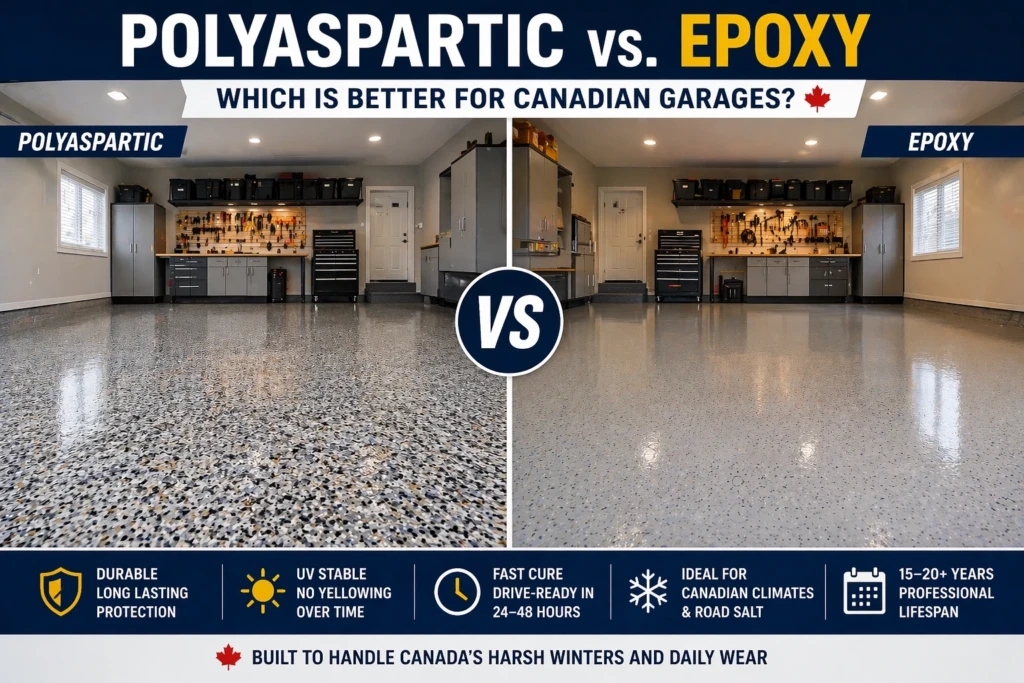
For most Canadian garages: Polyaspartic wins. It cures in one day, doesn’t yellow, handles our winters, resists road salt, and lasts 15–20+ years professionally installed.
If budget is your primary constraint: Quality epoxy is still a solid coating. It costs less upfront and, done right by a professional, will protect your floor for years.
The real mistake: Choosing the wrong one for YOUR garage based on someone else’s bias.
Now let’s go deeper because the details are what actually matter when you’re making a decision that’ll affect your garage floor for the next decade or two.
What Is Polyaspartic Floor Coating?
Polyaspartic is a type of aliphatic polyurea a resin-based coating chemistry that was originally developed in the early 1990s to protect steel bridges from corrosion. When researchers realized how fast it cured and how well it bonded to concrete, the floor coating industry took notice.
Today, professional-grade polyaspartic is the dominant choice for residential and commercial garage floor coatings across North America and for good reason.
1. How polyaspartic works
Polyaspartic is a two-component system: a resin and a hardener that are mixed immediately before application. Once combined, a chemical reaction begins and that reaction is fast. Depending on the formulation and ambient temperature, you have a working window of roughly 20–45 minutes per batch before it becomes too thick to spread properly.
That speed is both its biggest advantage and the reason DIY application is strongly discouraged. Professional installers are trained to work quickly, maintain consistent thickness, and manage batch timing so every square foot cures the same way.
2. What makes polyaspartic ideal for Canadian garages specifically
Here’s something most guides don’t say plainly: polyaspartic was designed for harsh environments. Bridges. Industrial facilities. Parking structures. The chemistry is engineered to flex with thermal expansion and contraction which is exactly what your garage floor does every time a Canadian winter turns into spring.
Key chemical advantages: Polyaspartic is water-soluble during application, which allows it to penetrate concrete pores more deeply than many epoxy formulations. It also contains UV-stable pigments, meaning it won’t yellow or amber over time even in a garage with south-facing windows.
What Is Epoxy Floor Coating?
Epoxy has been the standard garage floor coating for decades and it earned that reputation. A proper two-part epoxy system (not the thin single-component paint you find at big-box stores) creates a hard, chemical-resistant surface that protects concrete from spills, stains, and physical damage.
The chemistry is different from polyaspartic: epoxy uses a resin and a hardener that cross-link to form a rigid, thermoset plastic. That rigidity is what makes it so durable against abrasion and also what creates its main vulnerability in extreme temperature swings.
The epoxy spectrum: not all products are equal
This is a critical point that gets glossed over constantly. “Epoxy” describes a huge range of products:
- Water-based epoxy (consumer-grade): Thin, fast-dry, low durability. This is what’s in the kits at Home Depot. It looks decent for a year or two, then starts peeling. Not what professionals use.
- 100% solids epoxy (professional-grade): High-build, dense, far more durable. This is what a quality contractor installs. Volume solids of 85–100% mean very little off-gassing and a thick, long-lasting coating layer.
- Epoxy primer systems: Many professionals use high-quality epoxy as a base/primer coat because it bonds exceptionally well to concrete then top it with polyaspartic for UV resistance and durability. This hybrid approach is often the best of both worlds.
When we compare polyaspartic vs. epoxy in this guide, we’re comparing professional-grade systems not consumer kits vs. professional application. That’s an unfair and misleading comparison that a lot of our competitors make.
Head-to-Head Comparison: Polyaspartic vs. Epoxy (11 Factors)
Here’s the full comparison. We’ll go into detail on each factor below the table.
| Factor | Polyaspartic | Epoxy (Professional Grade) |
| Cure / Dry Time | 2–6 hrs per coat; drive-ready in 24–48 hrs | 24–72 hrs walk; 5–7 days vehicle |
| UV Resistance | Excellent no yellowing, ever | Will amber/yellow over time |
| Durability & Flex | Flexible resists freeze-thaw cracking | Rigid can micro-crack with temp swings |
| Hot Tire Pickup | Highly resistant | Moderate risk (esp. consumer-grade) |
| Road Salt Resistance | Excellent chemical resistance | Good (professional) / Poor (consumer) |
| Winter Application (Canada) | Applies down to −10°C | Requires minimum +10°C |
| Cost (Installed, Canada) | $8–$14/sq ft | $4–$9/sq ft |
| 10-Year ROI | Higher (lasts longer, less maintenance) | Lower (may need redo at year 7–10) |
| Lifespan (Professional) | 15–20+ years | 7–12 years |
| DIY Friendliness | Not recommended (too fast) | Possible with 100% solids kits |
| Aesthetic Options | High chips, metallic, solid colours | Very high widest colour range |
1. Cure Time: This changes everything about your week
Epoxy needs to cure at its own pace and it’s a slow one. Professional epoxy floors typically require 24–48 hours before foot traffic and 5–7 full days before you can park a vehicle on them. In a Canadian winter, when you need your garage every day, that’s a significant disruption.
Polyaspartic cures dramatically faster. Most professional installations allow foot traffic within a few hours and vehicle parking within 24–48 hours. A full installation surface prep, base coat, chip broadcast, topcoat is often completed in a single day.
That’s not marketing language. That’s the chemistry. Polyaspartic’s faster cross-linking reaction is simply done sooner.
2. UV Resistance: Why it matters for your garage
This is one of the clearest differences between the two coatings, and one that homeowners often underestimate when they’re choosing.
Epoxy is not UV-stable. It uses aromatic chemistry that reacts to ultraviolet light which means that any epoxy floor exposed to sunlight (through windows, an open garage door, or overhead skylights) will gradually yellow and amber. How quickly? It depends on sun exposure, but some homeowners notice discolouration within a year or two.
Polyaspartic uses aliphatic chemistry it’s UV-stable by design. The colour you install is the colour you keep, year after year. For garages with any natural light exposure, this is a meaningful advantage.
3. Durability & Flexibility: The freeze-thaw problem
This is where the Canadian climate turns a theoretical difference into a practical one.
Your concrete garage floor expands and contracts with temperature. In many parts of Canada, a single winter season involves dozens of freeze-thaw cycles temperatures swinging from −20°C to +5°C and back again. Over years, this thermal movement stresses rigid floor coatings.
Epoxy, once fully cured, is relatively rigid. It creates a strong bond, but it doesn’t flex much. Under repeated thermal stress, micro-cracks can develop and once the coating is cracked, moisture and road salt can work their way underneath.
Polyaspartic retains a degree of flexibility after curing. It moves with the concrete rather than fighting it. This is a significant long-term durability advantage in Canadian climates specifically.
4. Hot Tire Pickup: The silent garage floor killer
Hot tire pickup happens when a vehicle is parked in a cold garage, then driven the friction of driving heats the tires significantly. When those hot tires contact a floor coating that isn’t heat-resistant, the coating can soften slightly and literally peel away on the tire, leaving bare patches.
Consumer-grade epoxy is especially vulnerable. Professional epoxy systems are better, but they still have a higher threshold for this failure mode than polyaspartic.
Polyaspartic has a significantly higher heat deflection tolerance, making hot tire pickup essentially a non-issue. If you park vehicles in your garage especially in a Canadian winter-to-warm-morning scenario this matters.
5. Cost: What you actually pay in Canada
Let’s be direct, because most guides either hide the numbers or give US pricing that doesn’t translate.
| Coating Type | Cost Per Sq Ft (Installed) | Typical 2-Car Garage (450 sq ft) | Notes |
| Consumer-Grade Epoxy (DIY kit) | $0.50–$1.50/sq ft material only | $225–$675 material only | Short lifespan. Not recommended. |
| Professional Epoxy System | $4–$9/sq ft installed | $1,800–$4,050 installed | Durable. Good mid-tier option. |
| Professional Polyaspartic | $8–$14/sq ft installed | $3,600–$6,300 installed | Industry standard for Canadian garages. |
| Hybrid (Epoxy base + Poly topcoat) | $7–$12/sq ft installed | $3,150–$5,400 installed | Often the best value system. |
Important: These are Canadian market ranges for the GTA and surrounding regions. Pricing varies by city, floor condition, and prep required. Always get a written, on-site quote square-foot estimates over the phone are not reliable.
If you want to know the actuall price estimations for Garage Epoxy Flooring Accross Toronto – Read this full guide here: Garage Floor Cost in Toronto?
6. Lifespan: Which one actually lasts?
This is where the ROI math starts to shift the conversation.
| Coating | Professional Lifespan | DIY Lifespan | Maintenance Required |
| Polyaspartic | 15–20+ years | Not recommended for DIY | Minimal clean as needed |
| Professional Epoxy | 7–12 years | 2–5 years | Annual cleaning; may need topcoat refresh |
| Consumer Epoxy Kit | 2–5 years | 2–5 years | Peeling likely. Significant upkeep. |
Run the numbers: if professional epoxy at $6/sq ft lasts 8 years, that’s $0.75/sq ft per year. If professional polyaspartic at $11/sq ft lasts 18 years, that’s $0.61/sq ft per year. Over the long run, polyaspartic often costs less even with the higher upfront price.
7. Chemical & Road Salt Resistance
Road salt is a uniquely Canadian concern. Every winter, vehicles track in sodium chloride, calcium chloride, and magnesium chloride from treated roads. These compounds are corrosive and will degrade a coating that isn’t chemically resistant.
Professional polyaspartic has excellent resistance to the full spectrum of deicing chemicals. Professional epoxy is solid, but it’s less resistant to prolonged or repeated exposure particularly at the seams and edges where moisture can infiltrate.
This is one reason we recommend polyaspartic for most Canadian garages without hesitation. The chemical environment in a Canadian garage is genuinely harsher than in, say, a Florida or California garage.
8. Winter Application: A practical advantage most Canadians don’t know about
Epoxy requires a minimum application temperature of approximately +10°C and that temperature needs to be consistent throughout the curing period (up to a week). In most Canadian cities, that eliminates October through April as viable installation windows.
Polyaspartic can be applied in temperatures as low as −10°C, and its rapid cure time means the floor is protected before temperature fluctuations can interfere. This opens up the entire year for installation scheduling which also means you’re not competing with every other homeowner in the May–August peak window.
9. Moisture & Humidity Tolerance
Neither coating should be applied over concrete with elevated moisture vapour transmission this is true for both. Your installer should test for moisture before any application using a plastic sheet test or, better yet, a calcium chloride test.
What differs: during application, polyaspartic is less sensitive to ambient humidity than epoxy. Epoxy applied in humid conditions can develop an “amine blush” a greasy film that compromises adhesion and leaves a cloudy finish. Polyaspartic is more forgiving in real-world conditions.
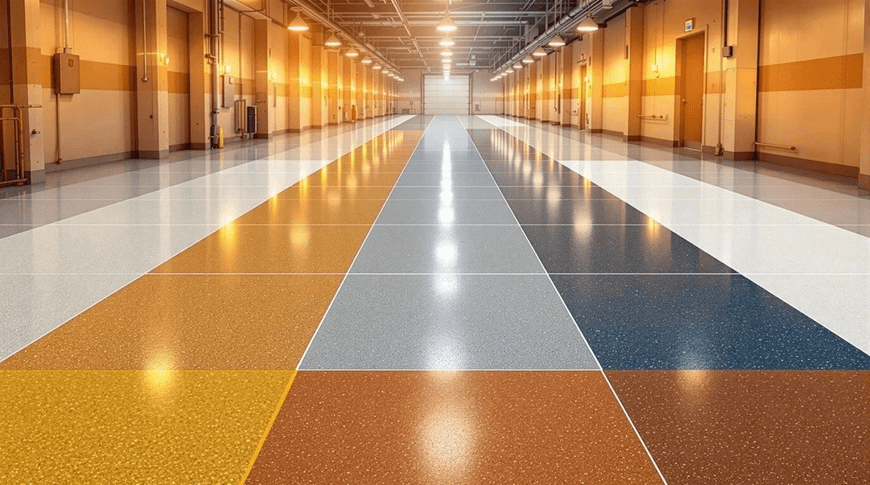
10. Aesthetics: Both look excellent
Honestly, this one comes down to personal preference. Both coatings can be done in:
- Full broadcast decorative flake (the most popular residential look)
- Solid colour from slate grey to warm beige
- Metallic and pearlescent finishes
- Custom patterns and multi-tone blends
The main visual difference is the finish quality over time. Polyaspartic’s UV stability means the colours stay true longer. Epoxy may show some shift in tone over years of sun exposure.
11. DIY vs. Professional Installation
Epoxy kits are designed to be DIY-able. If you’re handy, patient, and willing to do proper surface prep (which most DIYers underestimate), a quality 100% solids consumer epoxy can produce a decent result.
Polyaspartic is not designed for DIY. The working window is too short, the mixing ratios are precise, and the consequences of an error fish-eyes, delamination, uneven curing require professional correction. More than two people are typically needed. The risk of a failed application far outweighs the savings.
The honest DIY warning: The reason most garage floor coating failures you see online involve epoxy isn’t because epoxy is a bad product. It’s because the product was applied over unprepared concrete by a homeowner who didn’t grind the surface, didn’t test for moisture, and bought a $60 kit from a hardware store. The coating was doomed before a drop was rolled on. If you go DIY: use 100% solids epoxy, rent a floor grinder, test for moisture, and don’t skip the primer coat.
Canadian Climate: Why It Changes the Answer
We’ve touched on this throughout, but it deserves its own section because this is where the polyaspartic vs. epoxy conversation genuinely differs for Canadians compared to everyone else.
1. Freeze-thaw cycles and concrete movement
A typical Canadian winter in Ontario, Alberta, or Quebec involves dozens of freeze-thaw cycles. Each one puts stress on your concrete. If your floor coating can’t move with that stress, it will eventually crack, lift, or delaminate at the weakest points.
This is the single most important factor for Canadian garages, and it’s one of the main reasons polyaspartic has become the dominant professional recommendation in our market.
2. Road salt: your floor’s invisible enemy
Sodium chloride, calcium chloride, magnesium chloride the deicing chemicals used on Canadian roads are all corrosive. They get tracked in every time a vehicle enters the garage. Over years, they accumulate in the microscopic gaps in your concrete and, if your coating isn’t chemically sealed, they work their way under the coating and begin the cycle of delamination.
Professional polyaspartic creates a near-impermeable barrier. Road salt sits on top of the coating, not underneath it, and wipes away with a mop.
3. Application temperature windows
This is practical and often overlooked. If you’re renovating your garage this fall or planning ahead for next year, polyaspartic’s year-round application window means you’re not fighting for a booking slot in the 8-week peak summer window that every homeowner in the GTA is competing for.
We’ve installed polyaspartic floors in January in Ontario. We cannot do the same with epoxy and any contractor who tells you otherwise is taking a shortcut.
Polyurea vs. Polyaspartic vs. Epoxy: Clearing Up the Confusion
You’ll often see these three terms used interchangeably online. They’re not the same thing, and the confusion leads to homeowners making poorly-informed decisions.
| Coating | Chemistry | Cure Time | Best Use |
| Epoxy | Thermoset resin + hardener | Slow (24–72 hrs+) | Base coat, adhesion primer |
| Polyurea | Synthetic resin + isocyanate reactive | Very fast (minutes) | Industrial applications, spray applications |
| Polyaspartic | Modified polyurea (aliphatic) | Fast (2–6 hrs) | Garage topcoat, year-round residential |
The relationship: Polyaspartic is a subtype of polyurea. Think of polyurea as the broader family and polyaspartic as the refined version optimised for floor coating applications.
Pure polyurea is extremely fast-reacting sometimes curing in minutes which makes it nearly impossible to apply well in a residential setting. Polyaspartic slows that reaction just enough to make it workable while preserving most of the performance benefits.
Marketing red flag to watch for: Some companies advertise “polyurea/polyaspartic” as if the combination is something special. In reality, many floor systems use a polyurea base coat and a polyaspartic topcoat. That’s a legitimate and often excellent system but it should be described accurately, not used as a buzzword.
What Happens on Installation Day? (The Process Explained)
One of the best ways to evaluate a contractor is to understand what a proper installation should look like. If a company is quoting you 3 hours for a full garage floor, walk away.
Professional polyaspartic installation step by step
- Surface assessment and moisture testing. We check for cracks, spalling, oil stains, and test concrete moisture before anything goes on the floor.
- Diamond grinding. The concrete is mechanically ground to open the pores and create a mechanical key for adhesion. This step is non-negotiable. Shot blasting is an alternative on some surfaces.
- Crack repair and patching. Any structural cracks are filled with a compatible repair compound. Cosmetic cracks are addressed to prevent telegraphing through the topcoat.
- Primer / base coat application. A base coat is applied and the decorative flake (if using a broadcast system) is scattered into the wet coat.
- Flake cleanup and topcoat. Excess flake is removed, the surface is lightly sanded, and the clear polyaspartic topcoat is applied. This is where speed matters the crew needs to move efficiently and consistently.
- Quality check and cure. The floor is inspected for any missed areas, fisheyes, or inconsistencies. The homeowner is walked through care instructions.
Total time from start to finish: typically 6–10 hours for a standard 2-car garage. Walk-on time: 4–6 hours after topcoat. Vehicle traffic: 24–48 hours.
Common installation mistakes (and what they cost you)
These aren’t scare tactics they’re the actual failures we’re called in to fix when a cheaper contractor cuts corners.
- Skipping or rushing the grind: Leads to delamination within months. The coating peels off in sheets. The entire floor needs to be stripped and redone.
- Applying over sealed or painted concrete: Coatings need raw, open-pored concrete. Anything already on the surface blocks adhesion.
- Ignoring moisture: If the concrete is emitting moisture vapour above threshold levels, the coating will eventually bubble, blister, or lift
- One-person topcoat application: Polyaspartic requires at least two people applying in sync. One person will always be behind the pot life, leaving a visible line or colour variation in the finished floor.
- Using incompatible products: Mixing a polyaspartic topcoat over an epoxy base that isn’t formulated for it can cause adhesion failure. Always use a matched system from the same manufacturer.
Which One Should You Choose? An Honest Decision Framework
Here’s the thing most guides won’t say directly: polyaspartic is the right choice for most Canadian garages. But “most” doesn’t mean “all.” Here’s how to think through your specific situation.
Choose Polyaspartic if:
- You want the best long-term performance and the lowest 10-year cost
- Your garage gets direct sunlight through windows or an open door
- You park vehicles in the garage (hot tire pickup protection)
- Your budget is $3,500–$6,500 for a 2-car garage
- You want installation completed in a single day with minimal disruption
- Your garage is in Ontario, Alberta, Quebec, or anywhere with serious winters
- You want year-round scheduling flexibility
Consider Epoxy if:
- Budget is the primary constraint and you need the most floor for the dollar
- The garage is low-use (storage only, no vehicle parking
- You’re planning to sell the home within 3–4 years and want a fresh look without the premium investment
- You have a partial floor area (laundry room, basement, workshop) where long-term durability is less critical
When a hybrid system (epoxy base + polyaspartic topcoat) makes sense:
This is actually what many of our best installations look like. An epoxy primer bonds deeply to the concrete it’s slower and therefore wets out the surface more thoroughly. A polyaspartic topcoat then delivers UV stability, chemical resistance, and fast cure. You get the adhesion strength of epoxy and the surface performance of polyaspartic. Cost: typically $7–$12/sq ft installed. Ask your contractor specifically whether they offer this system.
Frequently Asked Questions
Is polyaspartic better than epoxy for garage floors?
For most Canadian garages, yes. Polyaspartic outperforms epoxy in UV resistance, cure time, flexibility (important for freeze-thaw climates), hot tire pickup resistance, and long-term lifespan. The main advantage of professional epoxy is lower upfront cost and wider colour availability.
How much does polyaspartic floor coating cost in Canada?
For a professionally installed system in the GTA and surrounding areas, expect $8–$14 per square foot. A standard 2-car garage (approximately 400–500 sq ft) typically costs $3,200–$7,000 installed, depending on floor condition, prep required, and the specific system chosen. Contact us for a free on-site estimate with exact pricing for your garage.
How long does polyaspartic floor coating last?
Professionally installed polyaspartic coatings typically last 15–20+ years with normal use. The key variables are surface preparation quality (the most important factor), product quality, and usage patterns. A floor installed with proper diamond grinding and manufacturer-matched products will dramatically outlast one that skipped prep.
Can epoxy floor coating be applied in a Canadian winter?
No not reliably. Professional epoxy requires a minimum application temperature of approximately +10°C, and that temperature needs to hold during the entire cure period (up to 7 days). Polyaspartic can be applied down to approximately −10°C and cures within hours, making it viable year-round across Canada.
Does polyaspartic resist road salt?
Yes, and this is a meaningful advantage for Canadian garages. Professional polyaspartic creates a chemically sealed surface that resists sodium chloride, calcium chloride, and magnesium chloride the common deicing salts tracked in from Canadian roads. Road salt sits on the surface and cleans off easily, rather than working under the coating.
What is the difference between polyurea and polyaspartic?
Polyaspartic is a subtype of polyurea specifically, an aliphatic polyurea formulated for floor coating applications. Pure polyurea cures so fast (sometimes in minutes) that it’s impractical for most residential installations. Polyaspartic slows the cure to a workable 2–6 hours while preserving most of polyurea’s performance advantages. Some floor systems use a polyurea base coat and a polyaspartic topcoat, which is a legitimate and high-performance combination.
Can I apply polyaspartic over my existing epoxy floor?
Sometimes, yes but it’s not simple. The existing coating needs to be in good condition (no peeling, bubbling, or delamination), properly abraded, and chemically compatible with the new product. In many cases, it’s better to remove the existing coating entirely and start fresh. A professional assessment will determine which approach is appropriate.
Is polyaspartic worth the extra cost?
Over a 10–15 year timeframe, yes for most Canadian garages. The math works out: polyaspartic at $11/sq ft lasting 18 years costs approximately $0.61/sq ft per year. Professional epoxy at $6.50/sq ft lasting 8 years costs approximately $0.81/sq ft per year. Add in the time and disruption of replacing the floor, and polyaspartic’s higher upfront cost often pays for itself.
How long after coating can I use my garage?
With a professional polyaspartic system: light foot traffic is typically possible within 4–6 hours. Vehicle traffic is safe at 24–48 hours. Full chemical cure (for maximum performance) takes approximately 72 hours. These timelines vary slightly based on temperature and humidity during installation.
Should I DIY my garage floor coating?
For epoxy: it’s possible if you use a quality 100% solids product, rent a floor grinder for proper surface prep, test for moisture, and follow the product instructions carefully. Consumer-grade kits often fail not because of the product, but because of inadequate surface preparation.
For polyaspartic: not recommended. The working window is too short, the mixing requires precision, and the consequences of a failed application are expensive to correct. Professional installation is strongly advised.
What warranty should I look for in a garage floor coating contractor?
Look for a written warranty that clearly specifies what’s covered (installation defects, delamination, peeling), the duration, and any conditions. Be skeptical of verbal warranties or “lifetime” claims without written documentation. Monarch Epoxy Coatings provides a written limited lifetime warranty on all professionally installed systems.
What cities in Ontario and Canada do you serve?
Monarch Epoxy Coatings serves the Greater Toronto Area and surrounding regions including Toronto, Mississauga, Brampton, Markham, Whitby, Oshawa, Hamilton, Barrie, Oakville, Burlington, Vaughan, Richmond Hill, and Newmarket. Contact us to confirm service availability in your area.